| DDAS or RAPID? |
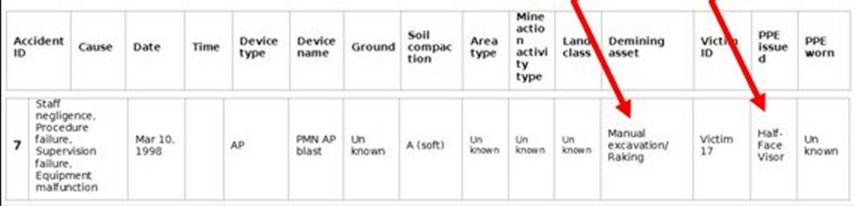
PLEASE READ THIS. This website is widely used. The most frequently visited page is DEMINER TRAINING. In 2015, Tajikistan became the first country to make all of its demining accident data available. Congratulations to the Tajikistan National Mine Action Centre (TNMAC), a government controlled body that has set an international standard for transparency. Despite its popularity, and the frequent reference made to the database when updating international and national Mine Action standards, the DDAS has no formal support. The nominal Humanitarian Mine Action industry leader is the United Nations Mine Action Service (UNMAS). UNMAS make no effort to collect and study accident records but, in 2011 when I left the IMAS Review Board, they began to support GICHD in an effort to collect data sheets (not full accident reports) which GICHD put into a spreadsheet that they call the RAPID database. GICHD took all of the detailed records in the DDAS and reduced them to a few words to start the RAPID spreadsheet, then instructed Mine Action Centres not to let me have access to their detailed accident data. This is an example of RAPID spreadsheet entry selected at random.
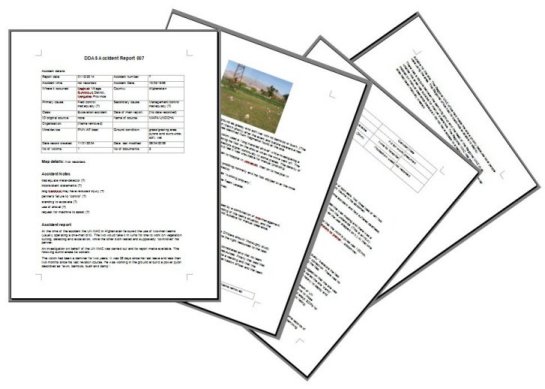
The same entry in the DDAS is rather more detailed...
The 2000 word report in my database has been reduced to 25 words, some of which are wrong. For example, a “half-face visor” was not used. This was a helmet mounted visor. Also, the data entry clerk does not discriminate between excavation and raking – despite the fact that a significant safety difference becomes obvious when using the detailed database instead of a simple spreadsheet. During 2014, GICHD added 22 accident records to RAPID. In all of them, data about the PPE used, the tools used, and the circumstances surrounding the accident was not recorded. Because you cannot derive any useful information from the RAPID database, researchers still ask me for details from what they call the Real Database (even people from GICHD have been obliged to ask me when they want detail). If lessons were "learned" and applied from the demining accidents on record, it is a very conservative estimate to claim that more than 40% of severely disabling demining injuries could be avoided. But the international mine action industry does not oblige the sharing of accident details, keeps no centralised accident record, and does not itself disseminate lessons learned from demining accidents. These failings would be unprofessional in a nominally "safe" industry - but in "Humanitarian Mine Action", I believe that it indicates gross negligence. It may even be a criminally negligent failure of Duty of Care - rendering all employers liable in litigation. Whatever else, their lack of professional concern in this area indicates that UNMAS (and GICHD) lack leadership and any genuinely "humanitarian" concern. Reluctantly, I continue to add accident records that come my way, but I can be in no great hurry to add them to this online resource when I know that the GICHD data entry clerk will immediately take them and trivialise them. However, I know they are useful, so all records will get added in the fullness of time. Field experienced people in this industry know that accidents are a fact of life. They also know that sharing accident expeience in a way that prevents any individual being named, blamed or pilloried is essential if we are to prevent repetition. I thank those who few who continue to send me data so that others can learn from unexpected experiences. By accessing these records you are agreeing to be restricted by the following…
The most common use of these records in training is to provide an example of what happens when things are done incorrectly. This can be a powerful reinforcement of a lesson about doing things correctly. This database can also be a training aid for paramedics and for field and office managers, and should be required reading for anyone with any responsibility for deminer safety. The links below only take you to a few examples of accidents that illustrate the need for appropriate equipment, training and disciplined procedures in demining. There are many others among the database records.
|
|